
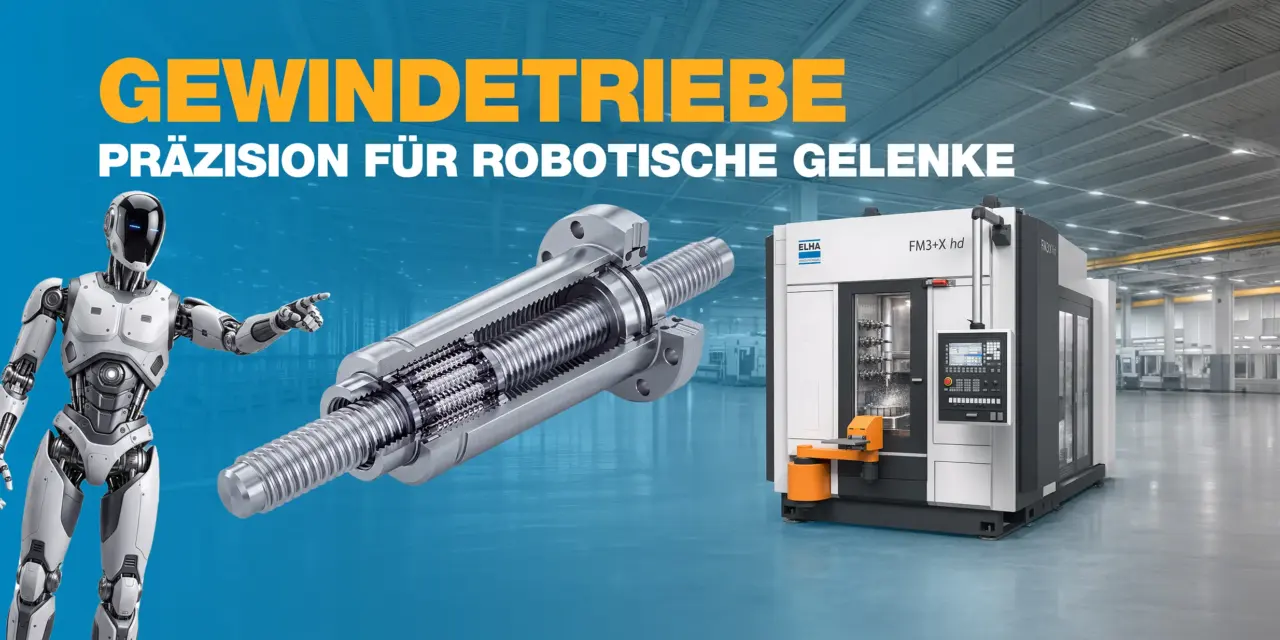
The current surge in the development of humanoid robots is not driven by any single technology. Advances in artificial intelligence, more powerful batteries, more compact sensor technology and falling hardware costs are now making applications possible that were still considered a vision of the future just a few years ago. At the same time, industry, logistics and the service sectors are seeking solutions to skills shortages and repetitive tasks. Humanoid robots are therefore regarded as one of the most promising areas of technology for the coming years.
The focus is often on AI and software. Less attention is paid to the mechanics, even though they are crucial for precision, durability and reliability. This is because every movement of a humanoid robot is based on highly precise drive components. Threaded drives, such as those used in numerous robotic joints, play a key role in this regard.
Screw drives: Precision for robotic joints
The joints of humanoid robots must meet several requirements: limited installation space, high dynamics, a long service life and maximum repeatability. Screw drives play a central role in this context. They convert rotational movements into precise linear movements, thereby enabling finely tuned motion sequences in arms, legs and gripper systems.
Depending on the application, different designs such as ball screws or roller screws are used. Roller screws, in particular, are becoming increasingly important in the field of humanoid robotics, as they can combine high load-carrying capacity, high dynamic performance and a long service life.
The key factor here is the quality of manufacture. Even the slightest deviations in pitch, concentricity or surface finish have a direct impact on the performance of the robot as a whole. For manufacturers of humanoid robots, this means that the performance of the end product depends on the precision of its individual components.
Why manufacturing determines success or failure
As humanoid robots move from prototypes to near-production applications, the demands placed on industrial manufacturing are increasing. Ball screws and similar precision components must not only be manufactured with precision, but also in a reproducible and process-reliable manner, and in ever-increasing quantities.
It has also been scientifically proven that the mechanical design of the joints plays a key role in this. A Review article by Kenji Hashimoto (Advanced Robotics, 2020) shows that even highly sophisticated control systems can only compensate to a limited extent for mechanical inaccuracies such as play, compliance or insufficient stiffness. The performance of humanoid robots is therefore largely determined by the precision of their mechanical components.
Developers of humanoid robots face a particular challenge today: the systems are expected to become lighter, faster, more precise and more cost-effective all at the same time. It is precisely this tension that places greater demands on the manufacturing process. Components are required that have tight tolerances and a high surface quality, whilst at the same time being reproducible and capable of being manufactured in increasing quantities.
This is where modern Production Modules . Our experience shows that they are the ideal solution for heavy-duty yet highly precise machining.
ELHA manufacturing modules are designed to produce complex precision components efficiently and with consistent results, and offer clear advantages:
- High process stability with tight tolerances
- Cost-effective production, even for larger production runs
- Flexible adaptation to different component geometries
- Reduced lead times through integrated processes
On these modules, we manufacture not only ball screws but also numerous other components used in robots. These include drive shafts, bearing housings, fasteners and structural precision parts. Our approach is clear: we do not consider components in isolation, but within the context of their future application and the planned production volumes.
Machining of high-strength materials such as titanium
Another key driver in the field of human-robot interaction is the use of high-strength materials. Materials such as titanium enable lightweight yet extremely robust designs, making them ideal for mobile robotic systems. At the same time, they place high demands on machine design, tooling technology and process control.
Our Production Modules are designed accordingly. In combination with specially developed tooling strategies, they enable cost-effective and stable machining, even with challenging materials. The key factors here are:
- Safe machining of challenging materials
- High surface quality for functionally critical components
- Predictable tool life
- Reliable production processes
For manufacturers and developers of humanoid robots, this means that we see ourselves not merely as mechanical engineers, but as manufacturing partners who take a holistic view of components, processes and industrial feasibility.
From development to mass production
Many of the humanoid robots presented today are still at the pilot project stage or in the early stages of series production. However, as market penetration increases, the focus will shift away from individual demonstrators towards the commercial production of large quantities.
This is precisely where one of the key challenges of the coming years lies. Threaded drives, drive components and structural parts must not only be manufactured with precision, but also be reproducible thousands of times over to a consistent standard of quality.
Highly productive manufacturing modules lay the groundwork for this. They combine precision with productivity and enable scalable manufacturing when applications are transitioned from the prototype stage to industrial-scale production. In our view, it is precisely this combination that will be crucial for the next stage of development in humanoid robotics.
Mass-production-ready precision for human-robot collaboration – ELHA manufacturing solutions
The market for humanoid robotics is developing at a rapid pace. Whilst new platforms and concepts are still emerging today, industrial scalability will increasingly determine market success in the future.
Screw drives and other precision components form the basis for reliable motion, high load-bearing capacity and a long service life. At the same time, it must be possible to manufacture these components cost-effectively and in large quantities.
With our manufacturing modules, we lay the groundwork for this: high precision, stable processes, sophisticated materials such as titanium, and a level of productivity that makes it economically viable to produce even increasing quantities.
Do you develop components for humanoid robots, or are you involved in the mass production of precision drive elements?
Then speak to our experts about materials, manufacturing concepts and scaling strategies. Together, we’ll find the right path from the component to cost-effective series production.
 German
  English
  French
  Spanish
  Italian
  Chinese
  Japanese